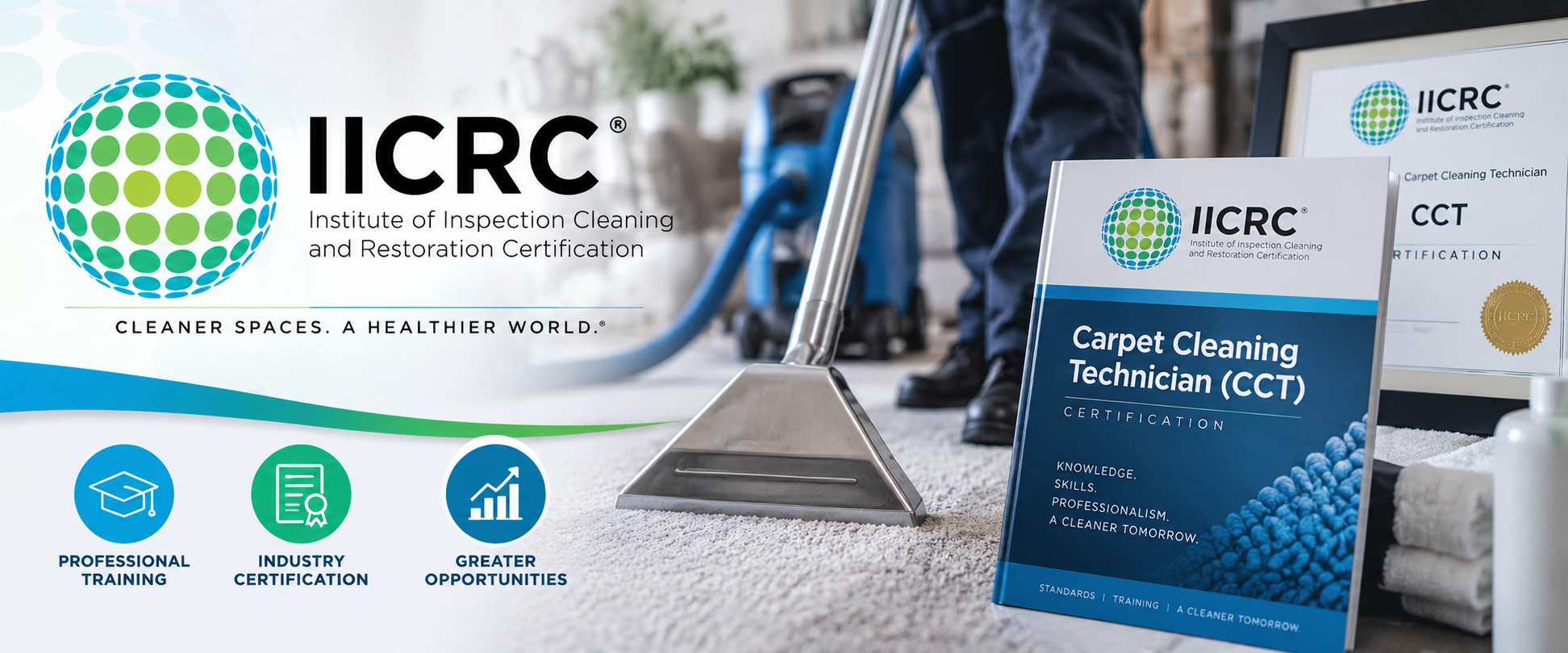
If you are researching IICRC Carpet Cleaning Technician Certification, you may be preparing to enter the cleaning industry, start a business, or build on skills you already have.
The Carpet Cleaning Technician certification, commonly called CCT certification, provides a foundation in professional carpet cleaning. The training covers carpet construction, fibers, soiling, cleaning chemistry, equipment, and proper techniques.
For someone beginning carpet cleaning training, understanding these fundamentals can reduce the guesswork when working with different carpets, stains, cleaning products, and equipment.
What Is the IICRC Carpet Cleaning Technician (CCT) Certification?
The Institute of Inspection, Cleaning and Restoration Certification (IICRC) develops standards and certifications for professionals in the inspection, cleaning, and restoration industries.
According to the IICRC’s CCT certification information, it covers the art and science of carpet cleaning, with an emphasis on practical application. Topics include yarn, fiber, and carpet construction; styles and finishes; soiling conditions; cleaning science; and proper methods.
There are no prerequisites for the certification, making it an accessible starting point for a carpet cleaning career. IICRC currently lists both in-person and live-stream certification options.
Who Should Enroll in CCT Training?
An IICRC carpet cleaning course can be useful for people at several stages of their careers, including:
- Individuals starting a carpet cleaning business who want technical training before working with customers
- Entrepreneurs exploring the cleaning industry before investing in equipment
- New carpet cleaning technicians who want formal education to supplement on-the-job training
- Existing cleaners who want to fill gaps in their technical knowledge
- Cleaning professionals interested in eventually pursuing additional IICRC certifications
The lack of prerequisites also means you don’t need years of industry experience before starting CCT training. If you’re ready to prepare for certification, learn more about DryMaster Systems’ CCT-IICRC Residential and Commercial Carpet Cleaning Seminar.
Keep in mind that completing the training and earning CCT certification are separate steps. The course provides the required training, while certification requires passing the IICRC exam.
What You’ll Learn in the CCT Certification Class
A CCT class covers several areas that work together during a professional carpet cleaning job.
Fiber and Carpet Construction
Not every carpet responds to cleaning in the same way. Technicians need to understand what they are working with before selecting products, equipment, or procedures.
IICRC includes fiber and fabric identification, yarn and carpet construction, styles, finishes, and proper cleaning procedures within CCT certification.
That knowledge helps a technician choose cleaning procedures appropriate for the material rather than relying on the same process for every carpet.
Soiling Conditions and Pre-Inspection
Professional cleaning begins before turning on the equipment.
Pre-inspection allows a technician to evaluate the carpet, identify potential concerns, and determine an appropriate cleaning process. The IICRC specifically includes pre-inspection among the skills addressed by CCT certification.
A technician may evaluate:
- Carpet type and construction
- Soil levels
- Spots and stains
- Existing wear or damage
- Areas that may require special attention
Documenting existing conditions can also help set realistic expectations with the customer before cleaning begins.
Cleaning Chemistry, Equipment, and Spotting
Professional carpet cleaning also requires an understanding of what cleaning products do and how they interact with different materials and soils.
The IICRC’s S100 Standard for Professional Cleaning of Textile Floor Coverings addresses cleaning chemistry, carpet fibers and construction, soil management, equipment and tools, cleaning methods, inspections, and spot and stain removal, among other subjects.
For a new technician, understanding the principles behind the process makes it easier to determine why a particular product, tool, or procedure fits a job.
Carpet Cleaning Methods and Procedures
A major part of carpet cleaning technician training is learning that professional carpet cleaning is not a one-method-fits-all service.
The IICRC S100 standard addresses multiple methods and systems for professional cleaning as part of a broader process that also includes carpet evaluation, soil management, equipment, safety, and inspections.
| Cleaning Method | General Purpose |
|---|---|
| Hot water extraction | Deep cleaning and soil removal |
| Encapsulation | Low-moisture cleaning and maintenance |
| Bonnet or absorbent pad cleaning | Surface-level maintenance cleaning |
| Dry compound cleaning | Cleaning where limited moisture is desirable |
Understanding hot water extraction training and other cleaning methods gives technicians a broader toolkit. The goal is not simply to learn how to operate equipment. It is to understand how carpet, soil, cleaning chemistry, equipment, and cleaning methods work together.
CCT Certification and IICRC Standards
CCT certification is part of a larger system of professional education and industry standards.
The ANSI/IICRC S100 Standard for Professional Cleaning of Textile Floor Coverings addresses professional commercial and residential carpet and textile floor-covering maintenance and cleaning. It covers cleaning principles, chemistry, carpet fibers and construction, soil management, equipment, safety, inspections, stain removal, residential cleaning, and area rugs.
IICRC standards are developed with input from industry professionals and other stakeholders and define best practices for professional cleaning, inspection, and restoration work.
One benefit of carpet cleaning certification is that technicians learn established industry principles instead of relying solely on techniques they pick up on the job.
Why CCT Can Be a Foundation for Advanced Training
CCT does not have to be the end of your professional carpet cleaning education.
It can also become part of a broader certification path. For example, IICRC requires CCT or Commercial Carpet Maintenance Technician (CCMT), along with additional certifications and time as an IICRC Certified Technician, for its Master Textile Cleaner, Master Fire and Smoke Restorer, and Master Water Restorer designations.
CCT is also a prerequisite for some individual certifications. For example, IICRC requires either CCT or Upholstery and Fabric Cleaning Technician (UFT) certification before you can take the Rug Cleaning Technician (RCT) certification.
Our guide to whether IICRC certification is worth it looks more closely at the value of continuing your education as your career or business develops.
From Classroom to Business: Putting Your Training to Work
Certification teaches technical principles, but running a carpet cleaning business also requires turning those principles into an efficient service.
Equipment is part of that equation. The right extractor should fit the types of jobs you plan to perform, your workload, and your business model. Our guide to choosing a carpet cleaning extractor covers factors to consider when selecting equipment.
As technicians gain experience, they may also decide to expand into related services. Area rug cleaning is one option that builds on some of the fiber and cleaning knowledge introduced in carpet cleaning training.
Career and Business Opportunities After CCT
Becoming an IICRC-certified technician can support several career paths. Depending on your goals, you might:
- Work as a technician for an established carpet cleaning or restoration company
- Start an independent carpet cleaning company
- Add carpet cleaning to an existing cleaning or restoration business
- Pursue additional certifications in textile cleaning, rug cleaning, restoration, or related specialties
- Work toward an IICRC Journeyman or Master designation
Technical knowledge is only one part of building a successful company, however. Pricing, marketing, equipment costs, customer acquisition, and the services you choose to offer all affect the business. Our guide to profitable cleaning business opportunities can help you consider those factors alongside your technical training.
How DryMaster Systems Supports Your CCT Training
DryMaster Systems combines technical education with resources for people who want to put that knowledge to work in the field.
Our education and training resources can help you explore professional instruction and choose the training that fits your goals.
If CCT is your next step, learn more about the skills and responsibilities involved in working as a carpet cleaning technician.
Training can give you the technical foundation. The next step is having the equipment and support necessary to turn those skills into services customers can hire you to perform. For entrepreneurs preparing to make that transition, our carpet cleaning business start-up package provides another place to start.
The IICRC Carpet Cleaning Technician Certification can be an entry point into professional carpet cleaning and a foundation for more advanced education. For a new professional carpet cleaner, the value goes beyond earning a credential. The training provides a better understanding of the materials, chemistry, equipment, and procedures behind the work—and a technical foundation you can continue building on throughout your career.